
When individuals develop mesothelioma or other severe asbestos-related illnesses, navigating the financial recovery system can feel overwhelming. Tens of billions of dollars sit in court-mandated trusts established by bankrupt asbestos manufacturers. However, securing the maximum possible payout requires far more than merely filling out standard administrative forms. It demands an aggressive, evidence-driven strategy that aligns documented work histories with precise product placements. To secure complete asbestos exposure compensation, claimants need seasoned trial litigators who understand how these funds evaluate occupational evidence.
At Danziger & De Llano, LLP, our legal team approaches trust claims with the rigorous precision of active courtroom litigators. Based in Houston, Texas, our firm represents trade workers, refinery personnel, shipyard crews, and industrial veterans across Texas and nationwide. Obtaining top-tier recovery from legacy trusts such as the Manville Personal Injury Settlement Trust and the DII Industries (Halliburton) Trust depends on detailed job description matching, historical exposure mapping, and thorough medical proof.
Understanding the Structure of Legacy Asbestos Bankruptcy Trusts
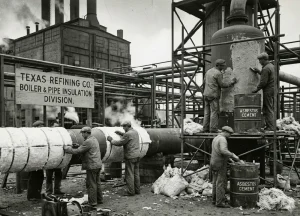
During the mid-to-late 20th century, companies like Johns-Manville and Halliburton subsidiaries (such as Harbison-Walker and Kellogg Brown & Root) manufactured or installed vast quantities of asbestos insulation, refractory bricks, and industrial sealants. Facing overwhelming tort liabilities, these entities sought Chapter 11 bankruptcy protection. Under Section 524(g) of the U.S. Bankruptcy Code, courts permitted these companies to reorganize while channeling all present and future asbestos liabilities into dedicated trust entities.
Today, every individual asbestos trust fund operates under strict Trust Distribution Procedures (TDP). These procedures define payment percentages, scheduled disease values, and specific evidentiary thresholds. Because trusts hold finite assets meant to pay victims over several decades, payment percentages adjust periodically. Consequently, receiving full financial recovery requires a comprehensive approach that targets multiple trusts simultaneously while establishing maximum exposure severity.
The Difference Between Expedited and Individual Review
When submitting a claim, injured workers generally choose between two review tracks:
- Expedited Review: A streamlined process designed to pay fixed, predetermined values quickly. While faster, expedited review often undervalues cases with unique exposure histories or severe economic losses.
- Individual Review: A detailed legal evaluation where attorneys present individualized proof regarding medical severity, lost earnings, and specific product identification. This pathway allows trial lawyers to negotiate higher awards for complex claims.
According to research by the RAND Institute for Civil Justice:
“Asbestos bankruptcy trusts were designed to offer an efficient alternative to traditional tort litigation, yet the total compensation a claimant receives remains highly dependent on establishing thorough documentation of exposure and disease severity across multiple trust funds.”
Strategic Blueprint for the Johns-Manville Trust Fund Allocation
Johns-Manville was once the world’s largest manufacturer of asbestos-containing thermal insulation, pipe covering, and building materials. As a result, its trust remains one of the foundational sources of recovery for industrial workers. Achieving an optimal Johns-Manville trust fund allocation requires proving that a worker interacted directly with specific branded products, such as Transite pipe, Thermobestos insulation, or Superex block insulation.
Matching Job Titles to Specific Exposure Sites
Trust administrators do not accept generalized statements of exposure. Instead, attorneys must connect exact job responsibilities to verified historical job sites. For instance, in Texas oil refineries, chemical plants along the Houston Ship Channel, and power generation facilities in Dallas, pipefitters, boilermakers, and insulators handled Johns-Manville thermal blocks daily.
A successful legal strategy involves assembling historical site rosters, purchase orders, co-worker affidavits, and union records. By proving that a worker mixed asbestos cement or cut Transite panels during specific years, lawyers establish the required exposure duration to trigger higher trust payment tiers.
Unlocking Maximum Halliburton Asbestos Claim Value
The DII Industries Trust handles legacy liabilities tied to Halliburton and its affiliated companies, including Harbison-Walker Refractories and KBR. Determining your true Halliburton asbestos claim value involves documenting exposure to high-temperature refractory bricks, cements, and drilling mud additives commonly used in heavy manufacturing, energy production, and maritime operations.
Industrial and Oilfield Exposure Patterns in Texas and Nationwide
Texas serves as the heart of America’s industrial and energy workforce. Workers in the Permian Basin oilfields, Beaumont shipyards, and Gulf Coast refineries were routinely exposed to Halliburton-distributed products. Drillers, refinery operators, and maintenance technicians frequently encountered asbestos muds and packing materials during routine equipment servicing.
To maximize recovery against the Halliburton trust, trial lawyers analyze work logs to verify that the claimant was present on sites during periods of documented product usage. Demonstrating secondary or direct contact with Harbison-Walker refractory linings in industrial furnaces significantly enhances case valuation under individual review standards.
Combining Multi-Trust Filings for Full Financial Recovery
Rarely was an industrial worker exposed to asbestos from a single manufacturer. A typical industrial facility contained thermal insulation from Johns-Manville, refractory materials from Halliburton subsidiaries, and valves or gaskets from other bankrupt manufacturers. Therefore, a complete recovery blueprint involves coordinated filings across dozens of distinct trusts.
Building a Courtroom-Ready Evidence Portfolio

Even when recovering money through administrative trust funds rather than active court trials, treating every claim as if it were heading to a jury yields superior results. A courtroom-ready portfolio includes:
- Pathological and Radiological Verification: Detailed pathology reports and high-resolution imaging confirming a definitive diagnosis of pleural or peritoneal mesothelioma.
- Detailed Occupational History: Chronological records detailing every job site, employer, military vessel, and specific job duty from initial employment through retirement.
- Corroborating Testimony: Sworn affidavits from former co-workers or site supervisors who can verify product brand names and exposure conditions.
- Economic Impact Analysis: Comprehensive documentation of medical expenses, future care costs, and loss of household earnings.
By integrating these evidentiary pillars, attorneys ensure that every available asbestos trust fund pays out at the highest allowable rate.
Why Partnering with Experienced Trial Lawyers Matters
Navigating the complex matrix of trust claims requires deep regional knowledge paired with nationwide litigation capability. While administrative clearinghouses or generic referral networks may process claims in bulk, actual litigators understand how trust recoveries interact with state-specific tort laws, third-party solvent lawsuits, and military VA benefits.
For example, in Texas, strict evidentiary standards govern asbestos litigation under state reform statutes. Having a law firm headquartered in Texas allows clients to leverage local court experience while simultaneously pursuing trust fund compensation across all 50 states. To explore detailed strategy options regarding your Johns-Manville trust fund allocation, consult with dedicated trial professionals who prioritize client dignity and financial justice.
If you or a family member has been diagnosed with an asbestos-related illness, our attorneys at Danziger & De Llano, LLP are ready to review your work history, identify liable manufacturers, and pursue every dollar of compensation you deserve.

Author: Mesothelioma Attorney Paul Danziger
Paul Danziger is a leading advocate for mesothelioma victims nationwide. As a co-founder of Danziger & De Llano, he and his team have recovered over $1 billion for their clients and helped thousands of asbestos victims and their families.

Reviewed by: Rodrigo De Llano, J.D.
Rod de Llano graduated from Princeton University with a Bachelor’s Degree in Economics. After graduation, he managed an import/export business before deciding to pursue a law degree.
Legal Disclaimer
The information provided is for educational and informational purposes only. The information on this website is not intended as legal advice and should not be used as a substitute for consulting a licensed attorney. Legal outcomes and laws can vary by jurisdiction, and only a qualified lawyer can provide guidance tailored to your situation.