
The vast oilfields of West Texas and the Permian Basin have long driven the American energy economy, but they have also left behind a heavy, silent toll. For decades, men and women working on drilling rigs, at pumping stations, and inside petrochemical facilities were routinely exposed to toxic mineral dust without their knowledge. Today, many of these former industrial workers face devastating diagnoses like malignant mesothelioma or asbestos-related lung cancer. Navigating the legal landscape to secure compensation for these illnesses requires a specialized understanding of the unique laws governing the Lone Star State. A key factor in these cases is whether an oilfield operator participated in the state workers’ compensation system or opted out, opening the door for a powerful Texas non-subscriber asbestos lawsuit.
For individuals who suffered toxic exposure while working for companies that opted out of traditional workers’ compensation coverage, the path to justice is distinct. Rather than being bound by the rigid and heavily capped administrative remedies of the state system, these individuals often have the right to file direct personal injury lawsuits against their former employers. When managing complex asbestos exposure claims, our firm utilizes a highly aggressive, dual-track recovery strategy. We aggressively pursue direct corporate liability lawsuits against negligent Texas non-subscriber oilfield operators while simultaneously securing maximum compensation from national bankruptcy trust funds. This coordinated approach ensures that corporate wrongdoers are held fully accountable while utilizing every available financial resource to support affected families.
Understanding Texas Non-Subscriber Rules and Asbestos Exposure Claims
Texas stands alone as the only state in the country that allows private employers to completely opt out of the state-regulated workers’ compensation insurance system. Companies that choose to carry standard workers’ compensation insurance are known as subscribers, and they receive broad statutory immunity from personal injury lawsuits brought by their employees. In contrast, employers that choose not to purchase state-regulated insurance are known as non-subscribers. While opting out allows these corporations to avoid paying state premiums and control their own internal benefit plans, it strips away their legal shield, leaving them completely exposed to direct civil litigation if an employee gets hurt or develops an occupational illness due to company negligence.
When an oilfield worker develops mesothelioma decades after their employment, the non-subscriber status of the company creates an entirely different legal framework for pursuing compensation. Under traditional workers’ compensation, an injured worker is legally barred from suing their employer for negligence and cannot recover compensation for non-economic damages like physical pain, suffering, or mental anguish. However, if the employer was a non-subscriber during the period of exposure, the injured worker is free to file a full personal injury lawsuit in Texas district courts, seeking unrestricted compensatory damages that far exceed the limited wage replacement benefits offered by the state administrative system.
Stripping Corporate Defenses Under Texas Labor Code Section 406.033
To discourage companies from opting out of the workers’ compensation system, the Texas Legislature enacted severe statutory penalties for non-subscribers. Under Section 406.033 of the Texas Labor Code, employers that opt out are explicitly stripped of the traditional common-law defenses that corporate defense attorneys routinely use to defeat personal injury claims. This statutory framework fundamentally levels the playing field for working-class families fighting against massive energy corporations and drilling contractors.
According to Texas Labor Code Section 406.033, in an action against an employer who does not have workers’ compensation insurance coverage to recover damages for personal injuries or death sustained by an employee in the course and scope of the employment, it is not a defense that the employee was guilty of contributory negligence, that the employee assumed the risk of injury or death, or that the injury or death was caused by the negligence of a fellow employee. Source: Texas Legislature Online.
In a standard personal injury case, a corporation will argue that the worker was partially at fault for their own injuries or that they fully understood the inherent risks of working in a dangerous oilfield environment. In a Texas non-subscriber case, these arguments are legally invalid. If a plaintiff can demonstrate that the employer’s operational negligence contributed even a fraction to the toxic exposure, the non-subscriber employer can be held liable for 100 percent of the resulting damages. The only viable liability defense remaining for the corporation is to prove that the employee’s own actions were the sole proximate cause of the illness, a legal hurdle that is incredibly difficult for a negligent company to clear when decades of widespread workplace contamination are documented.
Toxic Exposure in the Permian Basin: High-Risk Oilfield Operations
The Permian Basin oilfield toxic exposure epidemic stems from the heavy, historical reliance on asbestos products throughout the upstream, midstream, and downstream sectors of the oil and gas industry. Throughout the 1960s, 1970s, and 1980s, asbestos was widely celebrated by industrial manufacturers for its extraordinary heat resistance, high tensile strength, and chemical stability. Because oil drilling and refining operations involve extreme temperatures, volatile pressures, and corrosive chemical reactions, thousands of tons of asbestos-containing materials were integrated into the daily infrastructure of West Texas oilfields.
Roustabouts, roughnecks, derrickmen, pipefitters, pumpers, and refinery operators worked in environments where toxic fibers were constantly released into the air. Because mesothelioma carries a prolonged latency period lasting anywhere from 20 to 50 years between the initial inhalation of fibers and the clinical manifestation of the disease, many oilfield veterans who worked during the peak production eras are only now discovering the catastrophic damage done to their health.
Common Sources of Permian Basin Oilfield Toxic Exposure
Toxic airborne contamination occurred across multiple distinct phases of oilfield drilling and processing operations. Identifying these specific product exposures is critical to building an unassailable legal claim. Some of the most frequent sources of industrial exposure include:
- Drilling Mud Additives: From the mid-1960s through the mid-1980s, major chemical companies manufactured drilling mud additives that contained raw, chrysotile asbestos fibers under brand names like Visbestos and Flosal. Roughnecks and mud men were required to dump these finely ground powders directly into open mixing hoppers, creating thick, white dust clouds that were inhaled by everyone on the rig floor.
- Thermal Pipe Insulation and Vessel Lagging: High-pressure steam lines, mud lines, boilers, distillation towers, and heat exchangers were wrapped in thick asbestos insulation. Over time, due to intense vibrations, extreme weather, and regular maintenance, this insulation became friable, meaning it would easily crumble into a fine, powdery dust at the slightest touch.
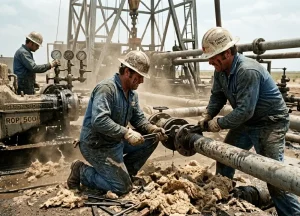
- Gaskets and Valve Packing: Flange gaskets and valve packing materials used across extensive pipeline networks and pump stations were fabricated from compressed asbestos sheets. Workers regularly had to scrape out old, degraded gaskets using wire brushes and power tools, generating concentrated, toxic dust in enclosed spaces.
- Brake Blocks on Mud Pumps and Drawworks: The heavy machinery utilized to raise and lower thousands of feet of drill pipe relied on massive industrial brake blocks containing asbestos. As these brakes were applied under immense mechanical strain, the friction wore down the linings, shedding toxic dust all over the rig structure.
Dual-Track Recovery Strategy: Direct Corporate Lawsuits vs. Asbestos Trust Funds
When an individual partner with a premier Texas mesothelioma attorney, they gain access to a sophisticated legal infrastructure designed to maximize financial recovery through multiple channels. We do not rely on basic informational indices or simple directory lookups. Instead, our legal team deploys a comprehensive dual-track litigation strategy tailored to the specific jurisdictional rules of the state of Texas.
Track one focuses on filing a powerful civil lawsuit against the non-subscriber oilfield operator or drilling contractor whose operational negligence directly caused the unsafe exposure. Track two runs concurrently, targeting the massive, national bankruptcy trust funds established by the manufacturing corporations that produced the toxic products used in the oilfields. By attacking the case from both angles, we secure full accountability from the local employers who failed to protect their workforce while recovering extensive damages from the multi-billion-dollar trusts set aside specifically for asbestos victims.
How Filing Direct Corporate Lawsuits Maximizes Payouts
Pursuing a direct civil lawsuit against a negligent non-subscriber company provides an avenue for compensation that traditional workers’ compensation simply cannot replicate. Because the statutory shields are removed, our legal team can pursue an array of substantial damages. We aggressively seek full compensation for past and future medical bills, complete reimbursement for lost wages, and compensation for the total loss of future earning capacity. Furthermore, we demand significant non-economic damages to address the profound physical pain, mental anguish, and diminished quality of life caused by a terminal cancer diagnosis.
In cases where an oilfield operator displayed conscious indifference to the known health hazards of asbestos, we can also seek punitive damages, also known as exemplary damages in Texas civil courts. Holding these major corporations directly accountable in front of a Texas jury creates substantial leverage, frequently resulting in high-value settlements before a trial even commences.
Accessing the Asbestos Trust Funds for Complete Financial Recovery
While a direct lawsuit targets the specific employer in Texas, the reality of the industrial supply chain means that multiple manufacturing companies share liability for the worker’s illness. Over the past several decades, dozens of major corporations that manufactured asbestos drilling additives, gaskets, insulation, and machinery filed for Chapter 11 bankruptcy protection due to the overwhelming volume of personal injury claims. As a condition of their restructuring, federal bankruptcy courts mandated that these corporations establish dedicated, multi-billion-dollar bankruptcy trust funds to compensate current and future victims.
Today, there is an estimated $30 billion remaining across active asbestos trusts. Because oilfield workers were exposed to multiple distinct types of asbestos products over the course of their careers, they are rarely limited to a single source of compensation. An experienced legal team can thoroughly investigate a worker’s employment history, match their specific tasks to documented products, and file separate, independent claims against multiple asbestos trust funds simultaneously. These trust fund payouts are processed outside of the traditional court system, providing crucial, rapid financial relief while the primary corporate lawsuit proceeds through the litigation phase.
Choosing an Elite Texas Trial Firm for Your Mesothelioma Claim

Asbestos litigation involving Texas non-subscriber employers is exceptionally complex, requiring deep regional knowledge and extensive experience handling industrial evidence. General personal injury lawyers who handle routine vehicular accidents or basic workers’ comp claims lack the investigative databases and technical resources required to successfully take on multi-billion-dollar energy conglomerates. To prevail, a family needs an elite trial firm with deep roots in Texas and a commanding nationwide reach.
At Danziger & De Llano, we possess the comprehensive legal infrastructure, the historical exposure databases, and the courtroom records necessary to hold corporate wrongdoers accountable. We handle every phase of the investigation, from tracking down historical corporate records and locating former coworkers to securing the exact medical documentation mandated by Texas statutes. We operate entirely on a contingency fee basis, meaning our clients never pay a single dollar in upfront fees or out-of-pocket costs. We only collect a fee if we successfully secure compensation for your family. If you or a loved one is facing a mesothelioma diagnosis after working in the West Texas oilfields, contact our dedicated legal team today to discuss your rights and begin your comprehensive claim process.

Author: Mesothelioma Attorney Paul Danziger
Paul Danziger is a leading advocate for mesothelioma victims nationwide. As a co-founder of Danziger & De Llano, he and his team have recovered over $1 billion for their clients and helped thousands of asbestos victims and their families.

Reviewed by: Rodrigo De Llano, J.D.
Rod de Llano graduated from Princeton University with a Bachelor’s Degree in Economics. After graduation, he managed an import/export business before deciding to pursue a law degree.
Legal Disclaimer
The information provided is for educational and informational purposes only. The information on this website is not intended as legal advice and should not be used as a substitute for consulting a licensed attorney. Legal outcomes and laws can vary by jurisdiction, and only a qualified lawyer can provide guidance tailored to your situation.